Timing of partial melting and granulite formation during the genesis of high to ultra‐high temperature terranes: Insight from numerical experiments
Long-lived high to ultra-high temperature (HT-UHT) granulitic terranes formed throughout Earth’s history. Yet, the detailed processes involved in their formation remain unresolved and notably the sequence of appearance and duration of migmatisation and granulites conditions in the orogenic cycle. These processes can be evaluated by analytical and numerical models. First, solving the steady-state heat equation allows underlining the interdependency of the parameters controlling the crustal geotherm at thermal equilibrium. Second, performing two-dimensional thermo-mechanical experiments of an orogenic cycle, from shortening to gravitational collapse, allows to consider non-steady-state geotherms and understand how deformation velocity may affect the relative timing of migmatite and granulite formation. These numerical experiments with elevated radiogenic heat production and slow shortening rates allow the formation of large volumes of prograde migmatites and granulites going through the sillimanite field as observed in many HT-UHT terranes. Finally, the interplay between these parameters can explain the difference in predicted pressure-temperature-time paths that can be compared with the natural rock archive.
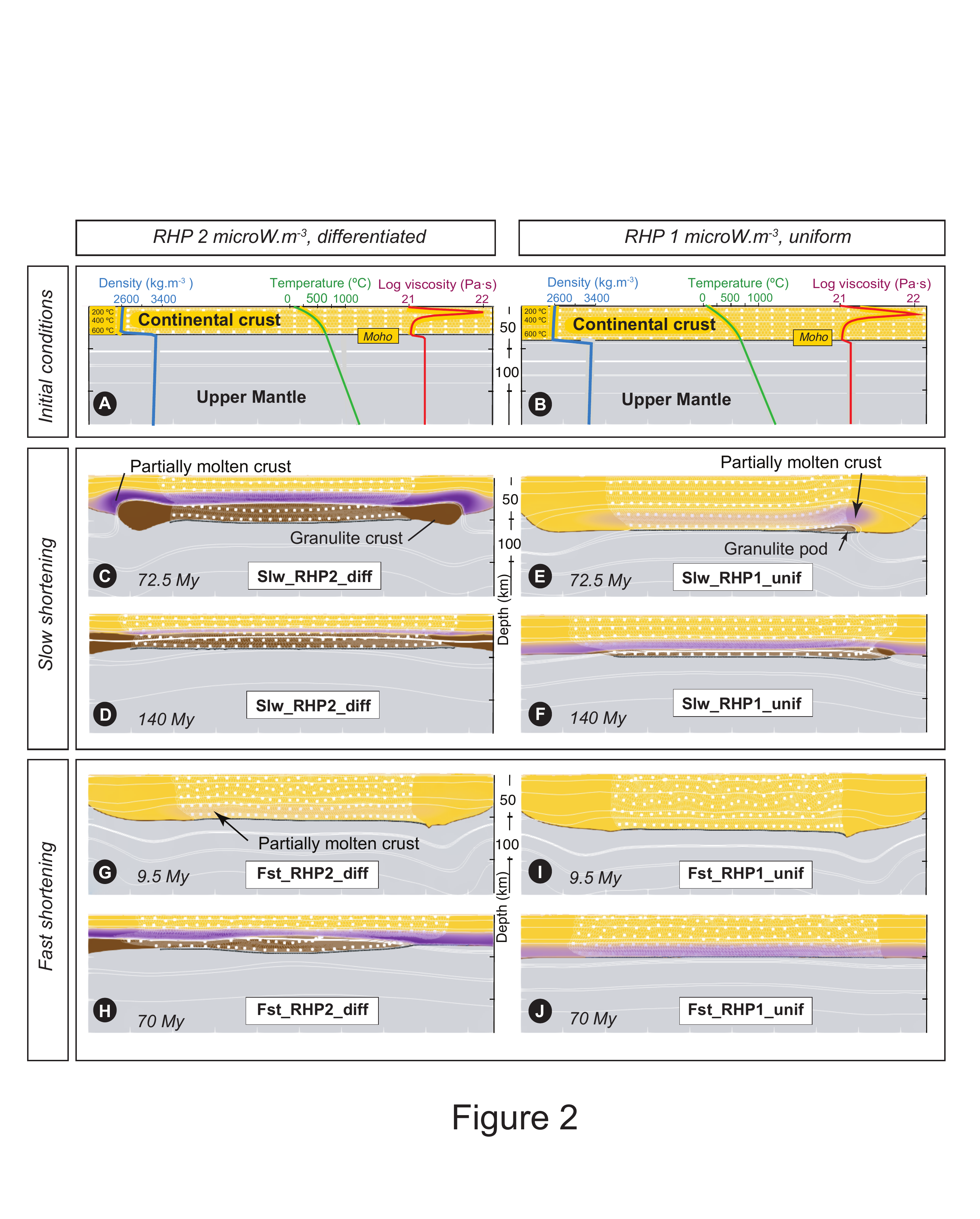
Figure 2. A-B. Model geometry, initial conditions as well as geotherm, viscosity and density profiles. The circles pattern superimposed on the continental crust represents the finite strain ellipses. White squares represent the Lagrangian particles recording the PTt paths presented in Fig. 4. A. Initial conditions for models RHP2_diff, mimicking a Proterozoic highly differentiated and highly radiogenic crust. B. Initial conditions for model RHP1_unif, simulating a Phanerozoic uniform and less radiogenic crust. C-J. Orogenic modeling results showing two snapshots for each model: i) shortening-delamination and ii) collapse. Shortening velocity is either slow (0.24 cm.y-1, C-F) or fast (2.4 cm.y-1, G-J).
Research Tags
None specified.
Associated Publication
Timing of partial melting and granulite formation during the genesis of high to ultra‐high temperature terranes: Insight from numerical experiments
Bénédicte Cenki, Patrice F. Rey, Diane Arcay, Julian Giordani
DOI10.1111/ter.12577
Abstract
Long‐lived high to ultra‐high temperature (HT‐UHT) granulitic terranes formed throughout Earth’s history. Yet, the detailed processes involved in their formation remain unresolved and notably the sequence of appearance and duration of migmatisation and granulites conditions in the orogenic cycle. These processes can be evaluated by analytical and numerical models. First, solving the steady‐state heat equation allows underlining the interdependency of the parameters controlling the crustal geotherm at thermal equilibrium. Second, performing two‐dimensional thermo‐mechanical experiments of an orogenic cycle, from shortening to gravitational collapse, allows to consider non‐steady‐state geotherms and understand how deformation velocity may affect the relative timing of migmatite and granulite formation. These numerical experiments with elevated radiogenic heat production and slow shortening rates allow the formation of large volumes of prograde migmatites and granulites going through the sillimanite field as observed in many HT‐UHT terranes. Finally, the interplay between these parameters can explain the difference in predicted pressure‐temperature‐time paths that can be compared with the natural rock archive.
Compute Tags
None specified.
Software
Underworld 2
https://doi.org/10.5281/zenodo.3975252 · https://zenodo.org/record/3975252
Model Setup
Model input and output files (NCI catalogue):
https://thredds.nci.org.au/thredds/catalog/nm08/MATE/cenki-2022-uht-granulitic-terranes/catalog.html
M@TE artifact:
https://github.com/ModelAtlasofTheEarth/cenki-2022-uht-granulitic-terranes
Dataset existing identifier:
10.25914/aaen-nc33
Citation
Cenki-Tok or Cenki, B., Rey, Patrice F.., Arcay, D., & Giordani, J. (2024). Timing of partial melting and granulite formation during the genesis of high to ultra‐high temperature terranes: Insight from numerical experiments [Data set]. AuScope, National Computational Infrastructure. https://doi.org/aaen-nc33
Licence
Funders
- European Union’s Horizon 2020 research and innovation program under grant agreement no 793978