Numerical Modeling of Earthquake Cycles Based On Navier-Stokes Equations With Viscoelastic-Plasticity Rheology
Numerical Modeling of Earthquake Cycles Based On Navier-Stokes Equations With Viscoelastic-Plasticity Rheology
The numerical modeling method for long-term tectonic deformations averages out the co-seismic fault displacement into thousands to tens of thousands of years, and neglects near-fault damages of earthquakes; therefore, it may not be able to decipher fault activities in detail. Software simulating earthquake rupture dynamics may not have a good estimation of background stress due to longterm tectonic deformations. In this study, we develop a numerical framework that embeds earthquake rupture dynamics into a long-term tectonic deformation model by adding inertial terms and using highly adaptive time-stepping that can capture deformation at plate-motion rates as well as individual earthquakes. The inertia term, which is neglected in long-term large-scale modeling methods, is considered to simulate the dynamic rupture processes. The rate-and-state frictional relationship for co-seismic fault slip is implemented in viscoelastic-plastic earth. Benchmarks of viscous flow, viscoelastic wave propagation and earthquake cycle simulations are tested. Based on these benchmarks, we undertake a generic study of a thrust fault in crust. We find that lower crustal rheology affects the periodic time of characteristic large earthquake cycles and the inter-seismic free surface movement. Cratons with a relatively strong lower crust due to lower temperature remain two peaks in surface uplift profiles around the fault zone for thousands of years after one characteristic earthquake, which help identify active faults in cratons.

Research Tags
Associated Publication
Numerical Modeling of Earthquake Cycles Based On Navier‐Stokes Equations With Viscoelastic‐Plasticity Rheology
Haibin Yang, Louis Moresi, Huihui Weng, Julian Giordani
DOI10.1029/2023gc010872
Abstract
Visco-elastic-plastic modeling approaches for long-term tectonic deformation assume that co-seismic fault displacement can be integrated over 1000s–10,000s years (tens of earthquake cycles) with the appropriate failure law, and that short-timescale fluctuations in the stress field due to individual earthquakes have no effect on long-term behavior. Models of the earthquake rupture process generally assume that the tectonic (long-range) stress field or kinematic boundary conditions are steady over the course of multiple earthquake cycles. This study is aimed to fill the gap between long-term and short-term deformations by modeling earthquake cycles with the rate-and-state frictional (RSF) relationship in Navier-Stokes equations. We reproduce benchmarks at the earthquake timescale to demonstrate the effectiveness of our approach. We then discuss how these high-resolution models degrade if the time-step cannot capture the rupture process accurately and, from this, infer when it is important to consider coupling of the two timescales and the level of accuracy required. To build upon these benchmarks, we undertake a generic study of a thrust fault in the crust with a prescribed geometry. It is found that lower crustal rheology affects the periodic time of characteristic earthquake cycles and the inter-seismic, free-surface deformation rate. In particular, the relaxation of the surface of a cratonic region (with a relatively strong lower crust) has a characteristic double-peaked uplift profile that persists for thousands of years after a major slip event. This pattern might be diagnostic of active faults in cratonic regions.
Compute Tags
None specified.
Software
Underworld
https://doi.org/10.5281/zenodo.3975252 · https://zenodo.org/record/3975252
Model Setup
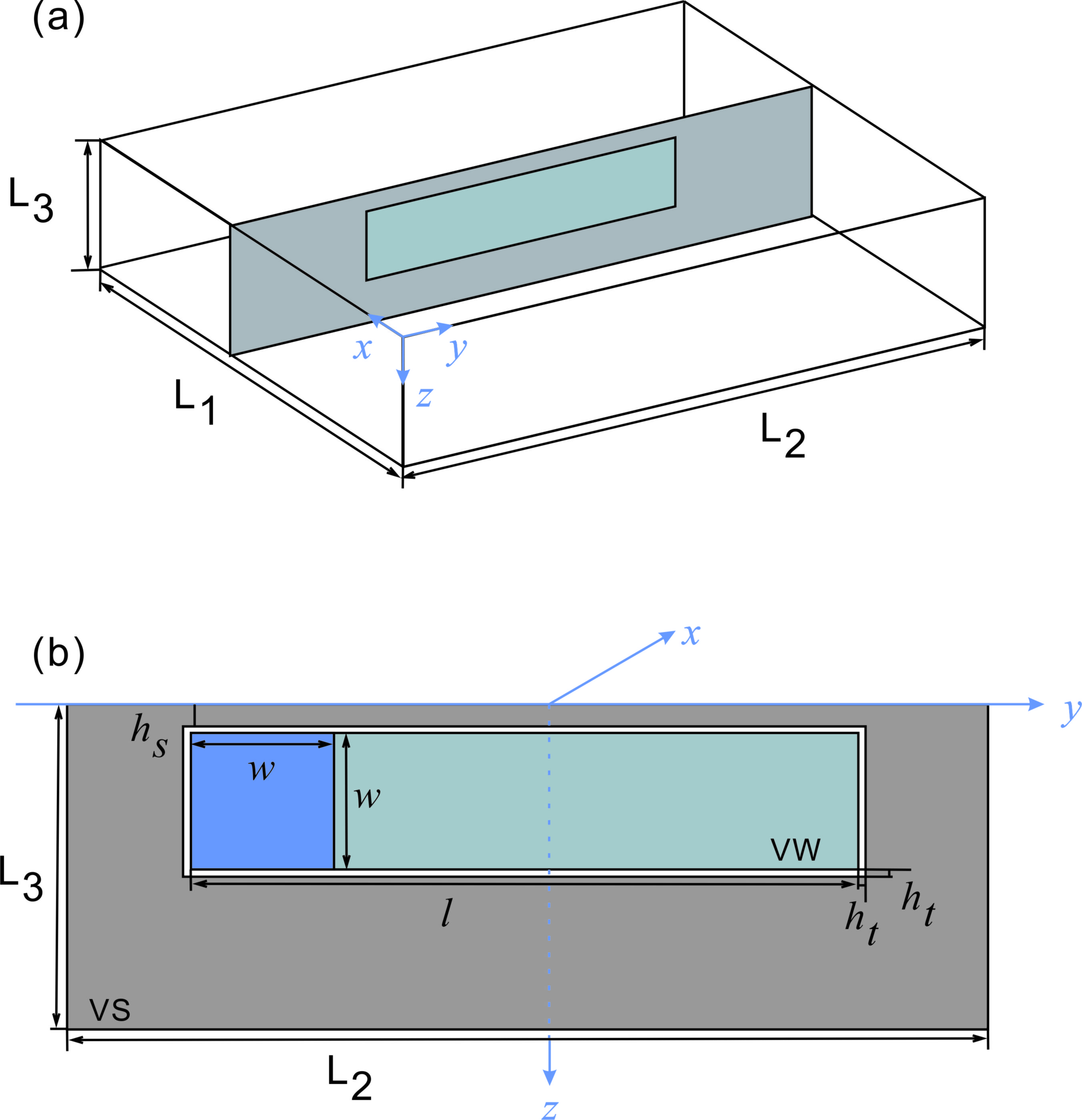
Figure 4. The benchmark model BP5 for 3D sequence of earthquakes and aseismic slip modeling. (a) A vertical planar fault is embedded in the middle of a homogenous, isotropic half-space with a free surface at z = 0. Fault behavior is controlled by the rate-and-state friction law. A periodic boundary condition is applied in y direction. (b) The velocity-weakening (VW) region (dark and light blue) is located within a transition zone (white), outside of which is the velocity-strengthening (VS) region (gray). In y and z directions, the frictional domain and VW region are (L2, L3) and (l, w), respectively. An initial nucleation zone (dark blue square with a width of w) is designed at the left end of the VW region.
Dataset (NCI catalogue):
https://thredds.nci.org.au/thredds/catalog/nm08/MATE/yang-2023-eqcycles/catalog.html
Dataset existing identifier:
10.25914/3jz9-mv44
Model files (NCI catalogue):
https://thredds.nci.org.au/thredds/catalog/nm08/MATE/yang-2023-eqcycles/catalog.html
Model files notes: Code and inputs for computational model
Source repository:
https://github.com/ModelAtlasofTheEarth/yang-2023-eqcycles
Citation
Yang, H., Moresi, Louis., Weng, H., & Giordani, J. (2024). Numerical Modeling of Earthquake Cycles Based On Navier-Stokes Equations With Viscoelastic-Plasticity Rheology [Data set]. AuScope, National Computational Infrastructure. https://doi.org/3jz9-mv44
Licence
Funders
- National Natural Science Foundation of China
- National Computational Infrastructure