Kinematics of Footwall Exhumation at Oceanic Detachment faults: Solid‐Block Rotation and Apparent Unbending
Kinematics of Footwall Exhumation at Oceanic Detachment faults: Solid‐Block Rotation and Apparent Unbending
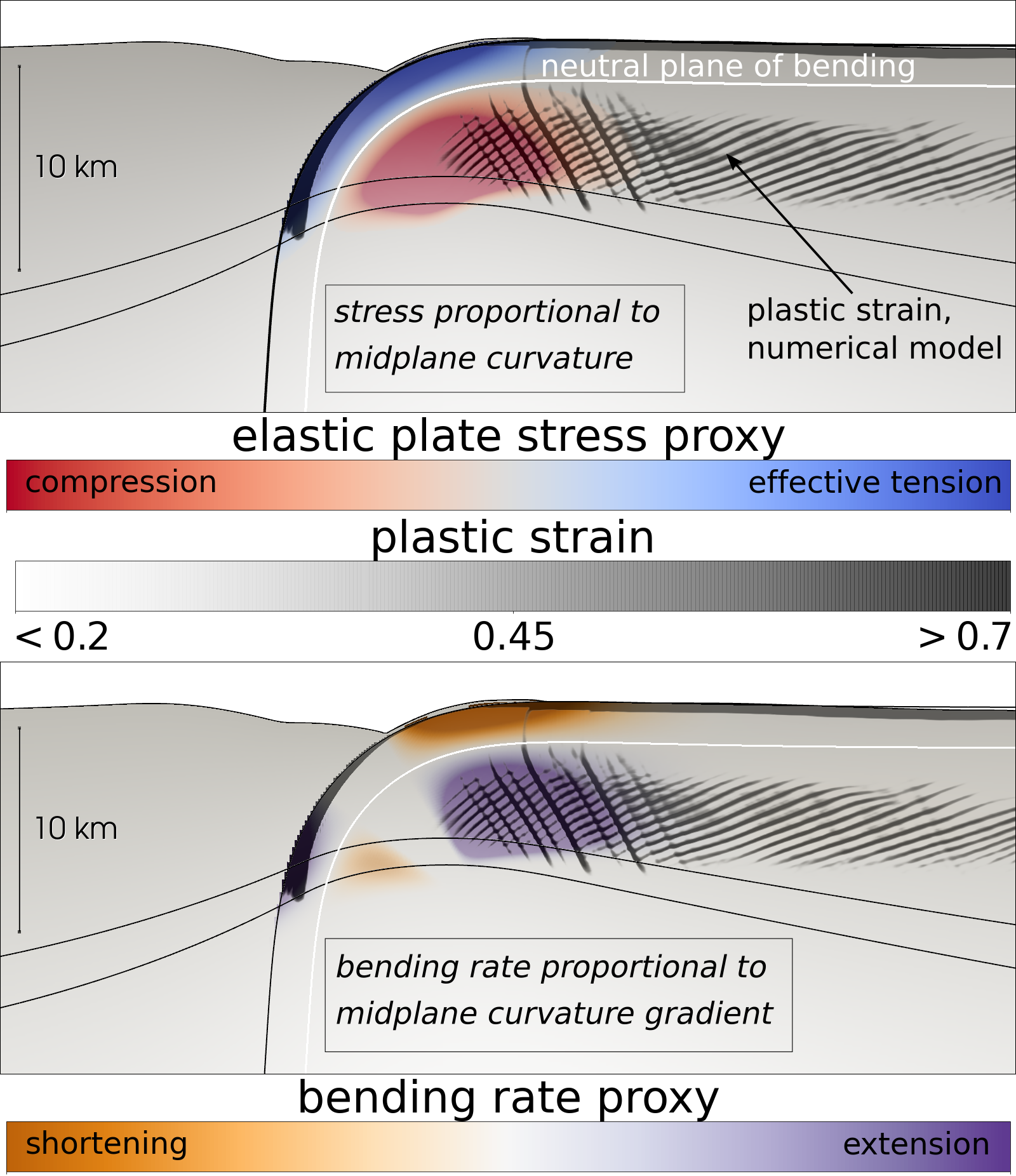
This model was developed in order to study the rotation of footwall rocks beneath oceanic detachment faults (ODFs). It showed that solid-block rotation dominates beneath a concave-down fault, while significant flexural stresses form later during apparent unbending, causing both compression and extension-related brittle strain within oceanic core complexes (OCCs).
Animation showing alternative model (see paper for detail). Colormap shows vorticity/rotation rate. Velocity vectors are shown in the hangingwall reference frame. Dark regions show the acccumulation of plastic strain.
Research Tags
Associated Publication
Kinematics of Footwall Exhumation at Oceanic Detachment faults: Solid‐Block Rotation and Apparent Unbending
Dan Sandiford, Sascha Brune, Anne Glerum, John Naliboff, Joanne M. Whittaker
DOI10.1029/2021gc009681
Abstract
Seafloor spreading at slow rates can be accommodated on large‐offset oceanic detachment faults (ODFs), that exhume lower crustal and mantle rocks in footwall domes termed oceanic core complexes (OCCs). Footwall rocks experience large rotation during exhumation, yet important aspects of the kinematics—particularly the relative roles of solid‐block rotation and flexure—are not clearly understood. Using a high‐resolution numerical model, we explore the exhumation kinematics in the footwall beneath an emergent ODF/OCC. A key feature of the models is that footwall motion is dominated by solid‐block rotation, accommodated by the nonplanar, concave‐down fault interface. A consequence is that curvature measured along the ODF is representative of a neutral stress configuration, rather than a “bent” one. Instead, it is in the subsequent process of “apparent unbending” that significant flexural stresses are developed in the model footwall. The brittle strain associated with apparent unbending is produced dominantly in extension, beneath the OCC, consistent with earthquake clustering observed in the Trans‐Atlantic Geotraverse at the Mid‐Atlantic Ridge.
Compute Tags
None specified.
Software
Software information not available.
Model Setup
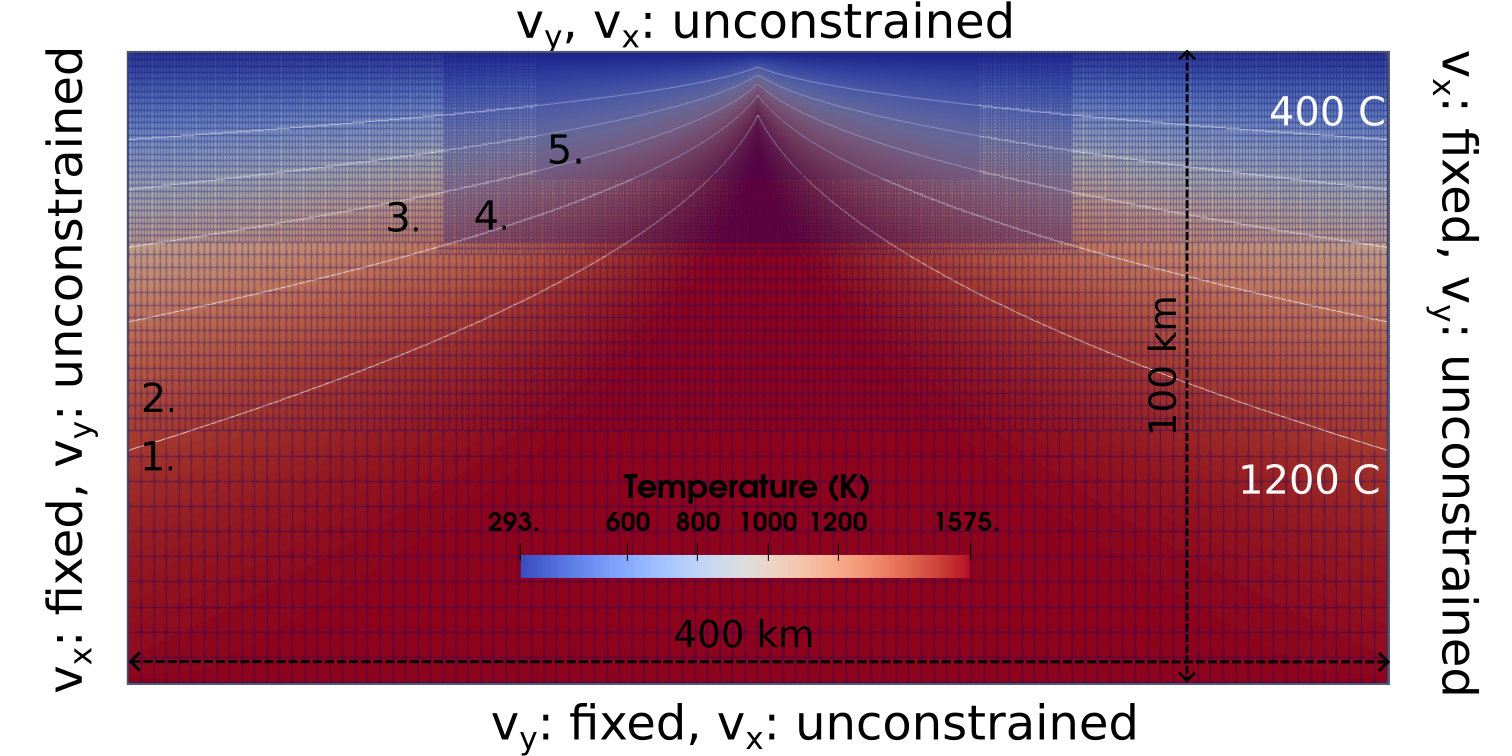
Initial conditions, showing mesh refinement.
Dataset (NCI catalogue):
https://thredds.nci.org.au/thredds/catalog/nm08/MATE/sandiford-2021-detachment/catalog.html
Dataset existing identifier:
10.25914/r3ya-bg54
Dataset notes: Data directory contains output data for 2 simulations stored in the following directories: ref_model_hires, alt_model_hires. Top level contains typical ASPECT output files, including log.txt and restart files. Topography and mesh variables were output at 100 Kyr intervals. Model end time is 5 Myr. Main output data consists of of plain text files representing model topography (e.g. topography.00000), vtu files (in the ./solution sub-directory) representing model output fields (e.g. solution-00000.0000.vtu). At each output step, there are 16 vtu files written. These can be opened with Paraview using the solution.pvd file in the top level.
Model files (NCI catalogue):
https://thredds.nci.org.au/thredds/catalog/nm08/MATE/sandiford-2021-detachment/catalog.html
Model files existing identifier:
https://github.com/dansand/odf_paper
Model files notes: Code and inputs for computational model
Source repository:
https://github.com/ModelAtlasofTheEarth/sandiford-2021-detachment
Citation
Sandiford, D., Brune, S., Glerum, A., Naliboff, J., & Whittaker, J. (2024). Kinematics of Footwall Exhumation at Oceanic Detachment faults: Solid‐Block Rotation and Apparent Unbending [Data set]. AuScope, National Computational Infrastructure. https://doi.org/r3ya-bg54
Licence
Funders
- Australian Research Council