ISMIP-HOM benchmark experiments using Underworld
ISMIP-HOM benchmark experiments using Underworld
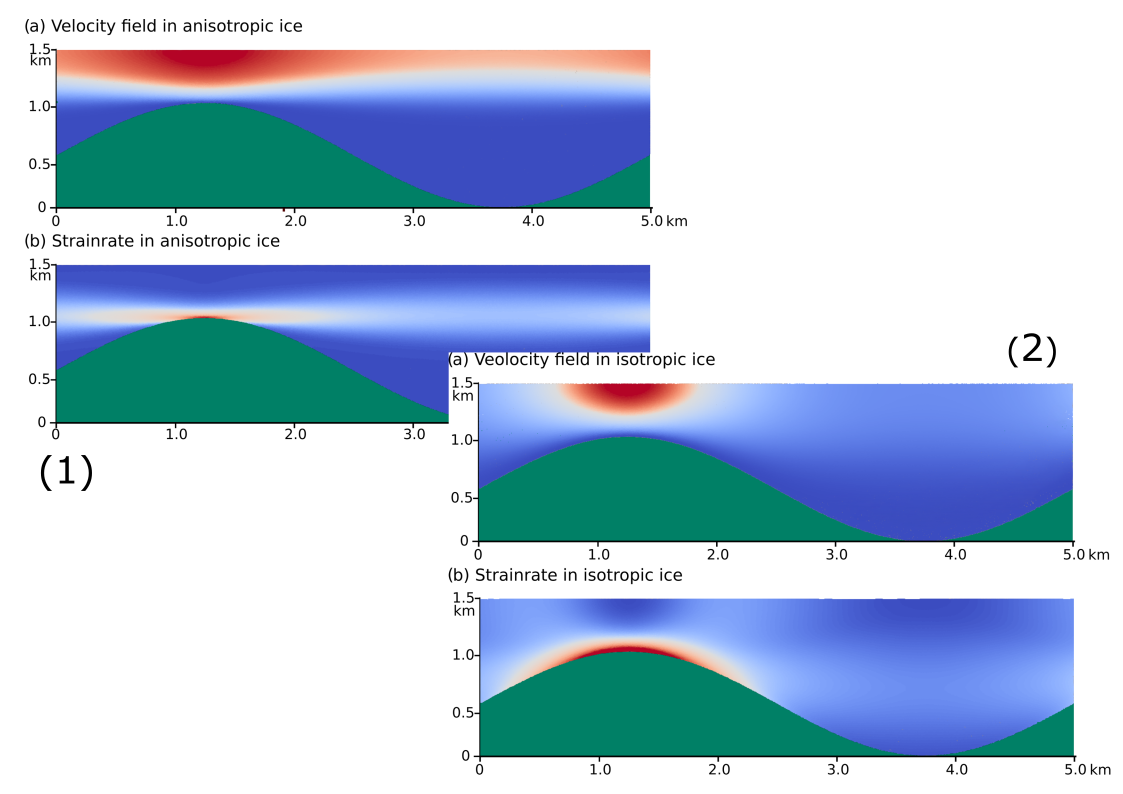
Knowledge of the internal structures of the major continental ice sheets is improving, thanks to new investigative techniques. These structures are an essential indication of the flow behavior and dynamics of ice transport, which in turn is important for understanding the actual impact of the vast amounts of water trapped in continental ice sheets on global sea-level rise. The software studied here is specifically designed to simulate such structures and their evolution.

Research Tags
Associated Publication
ISMIP-HOM benchmark experiments using Underworld
Till Sachau, Haibin Yang, Justin Lang, Paul D. Bons, Louis Moresi
DOI10.5194/gmd-15-8749-2022
Abstract
Abstract. Numerical models have become an indispensable tool for understanding and predicting the flow of ice sheets and glaciers. Here we present the full-Stokes software package Underworld to the glaciological community. The code is already well established in simulating complex geodynamic systems. Advantages for glaciology are that it provides a full-Stokes solution for elastic–viscous–plastic materials and includes mechanical anisotropy. Underworld uses a material point method to track the full history information of Lagrangian material points, of stratigraphic layers and of free surfaces. We show that Underworld successfully reproduces the results of other full-Stokes models for the benchmark experiments of the Ice Sheet Model Intercomparison Project for Higher-Order Models (ISMIP-HOM). Furthermore, we test finite-element meshes with different geometries and highlight the need to be able to adapt the finite-element grid to discontinuous interfaces between materials with strongly different properties, such as the ice–bedrock boundary.
Compute Tags
None specified.
Software
Underworld2: Python Geodynamics Modelling for Desktop, HPC and Cloud
https://doi.org/10.5281/zenodo.5935717 · https://zenodo.org/record/5935717
Model Setup
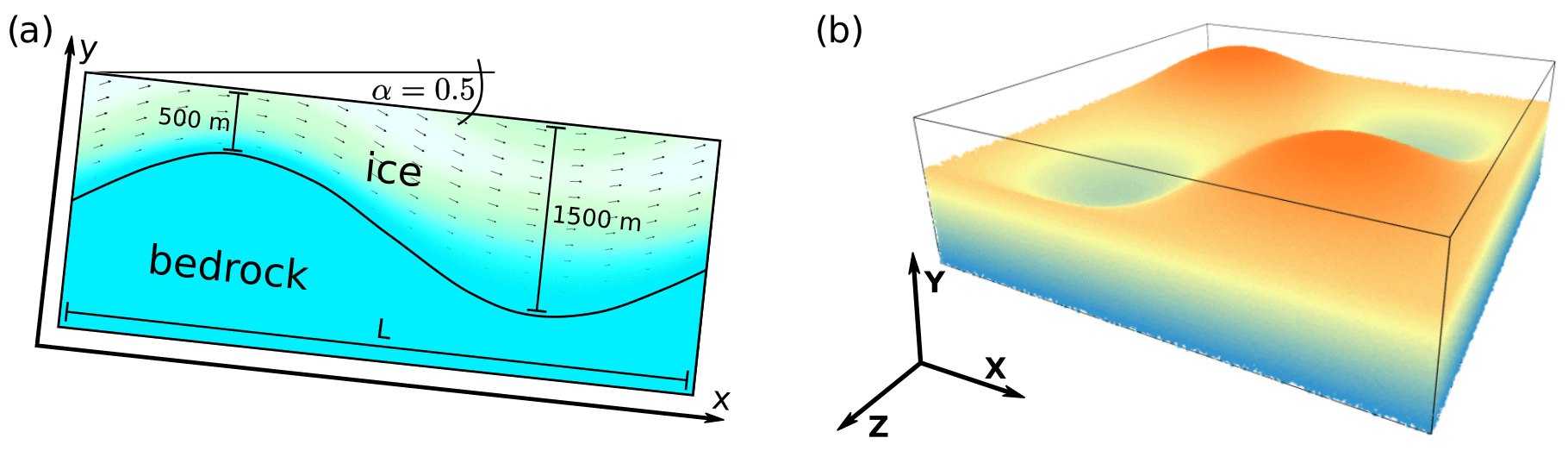
(a) 2D geometry of Experiment B. This is identical to a section parallel X located at yˆ = 0.25 in Experiment A (right). Sloping angle α is given in degrees. Also depicted is the velocity field of the flowing ice, resulting for a model width L of 5000 m from the simulations described below. Color and arrow length visualize the amount of velocity. (b) Bedrock topography for Experiment A and general naming scheme for the axes of 3D experiments.
Dataset (NCI catalogue):
https://thredds.nci.org.au/thredds/catalog/nm08/MATE/sachau-2022-icesheet/catalog.html
Dataset existing identifier:
10.25914/fhew-h678
Model files (NCI catalogue):
https://thredds.nci.org.au/thredds/catalog/nm08/MATE/sachau-2022-icesheet/catalog.html
Model files existing identifier:
10.5281/zenodo.7384424
Model files notes: Code and inputs for computational model
Source repository:
https://github.com/ModelAtlasofTheEarth/sachau-2022-icesheet
Citation
Sachau, T., Yang, H., Bons, P., & Moresi, Louis. (2024). ISMIP-HOM benchmark experiments using Underworld [Data set]. AuScope, National Computational Infrastructure. https://doi.org/fhew-h678
Licence
Funders
- AuScope
- University of Tübingen