The Role of Lithospheric-Deep Mantle Interactions on the Style and Stress Evolution of Arc-Continent Collision
The Role of Lithospheric-Deep Mantle Interactions on the Style and Stress Evolution of Arc-Continent Collision
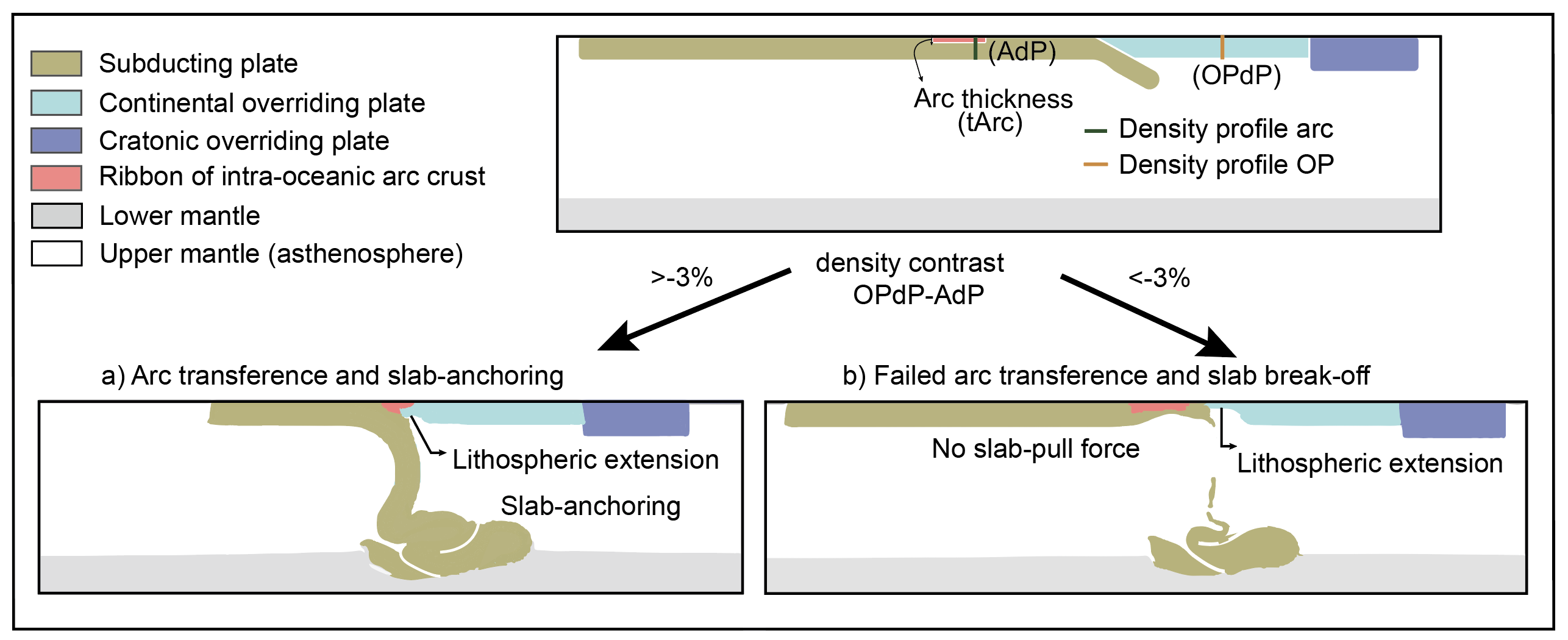
The model is designed to investigate the role of buoyancy contrasts in determining the style of arc-continent collision and the stress and strain evolution in the continental plate
Evolution of less buoyant arc-continent collision. This style of collision results in arc transference to the continental overriding plate.
Research Tags
Associated Publication
The Role of Lithospheric‐Deep Mantle Interactions on the Style and Stress Evolution of Arc‐Continent Collision
Andrés Felipe Rodríguez Corcho, Sara Polanco, Rebecca Farrington, Romain Beucher, Camilo Montes, Louis Moresi
DOI10.1029/2022gc010386
Abstract
We investigate how the mechanical properties of intra-oceanic arcs affect the collision style and associated stress-strain evolution with buoyancy-driven models of subduction that accurately reproduce the dynamic interaction of the lithosphere and mantle. We performed a series of simulations only varying the effective arc thickness as it controls the buoyancy of intra-oceanic arcs. Our simulations spontaneously evolve into two contrasting styles of collision that are controlled by a 3% density contrast between the arc and the continental plate. In simulations with less buoyant arcs (15–31 km; effective thickness), we observe arc-transference to the overriding plate and slab-anchoring and folding at the 660 km transition zone that result in fluctuations in the slab dip, strain-stress regime, surface kinematics, and viscous dissipation. After slab-folding occurs, the gravitational potential energy is dissipated in the form of lithospheric flow causing lithospheric extension in the overriding plate. Conversely, simulations with more buoyant arcs (32–35 km; effective thickness) do not lead to arc-transference and result in slab break-off, which causes an asymptotic trend in surface kinematics, viscous dissipation and strain-stress regime, and lithospheric extension in the overriding plate. The results of our numerical modeling highlight the importance of slab-anchoring and folding in the 660 km transition zone on increasing the mechanical coupling of the subduction system.
Compute Tags
None specified.
Software
Underworld2
https://doi.org/10.5281/zenodo.3996738
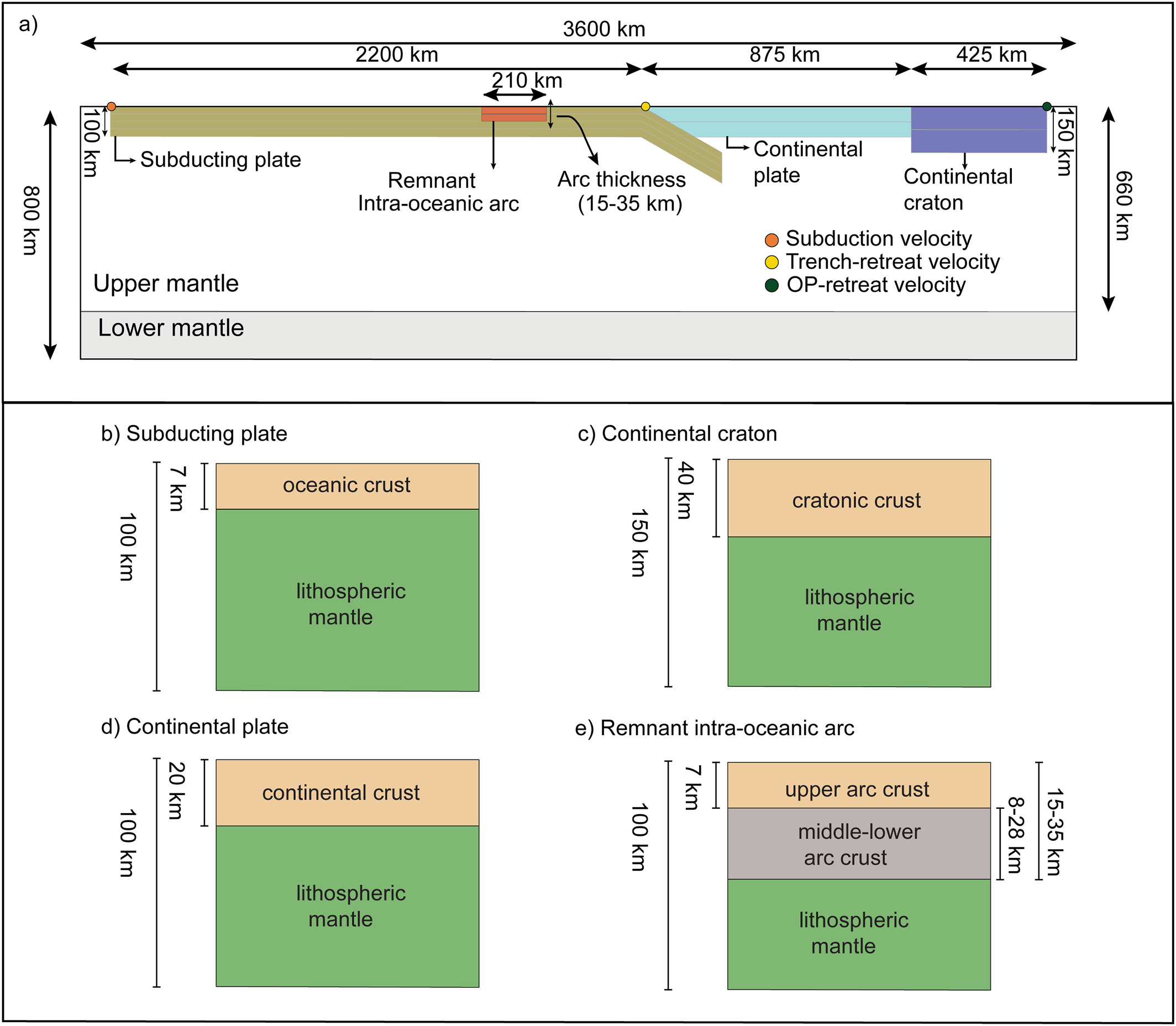
Model Setup
Dataset (NCI catalogue):
https://thredds.nci.org.au/thredds/catalog/nm08/MATE/RodriguezCorcho-2022-ArcCollision/catalog.html
Dataset existing identifier:
10.25914/xy60-b940
Dataset notes: The output consists of xdmf and h5 files. There is one xdmf file per time step (every 0.5 Myr) and a set of h5 files that contain the distinct model properties.
Model files (NCI catalogue):
https://thredds.nci.org.au/thredds/catalog/nm08/MATE/RodriguezCorcho-2022-ArcCollision/catalog.html
Model files existing identifier:
https://github.com/andresrcorcho/Dynamics-of-Arc-Continent-Collision
Model files notes: Code and inputs for computational model
Source repository:
https://github.com/ModelAtlasofTheEarth/RodriguezCorcho-2022-ArcCollision
Citation
Rodríguez Corcho, A., Polanco, S., Farrington, R., Beucher, R., Montes, C., & Moresi, L. (2024). The Role of Lithospheric-Deep Mantle Interactions on the Style and Stress Evolution of Arc-Continent Collision [Data set]. AuScope, National Computational Infrastructure. https://doi.org/xy60-b940
Licence
Funders
- Australian Research Council’s ITRH Project
- Colombian Government PhD Scholarship
- Colombian Association of Petroleum Geologists and Geophysicists
- Auscope
- Nectar Research Cloud
- National Computational Infrastructure