Flexural isostatic response of continental-scale deltas to climatically driven sea level changes
Flexural isostatic response of continental-scale deltas to climatically driven sea level changes
Two-thirds of the world’s most populated cities are situated close to deltas. We use computer simulations to understand how deltas sink or rise in response to climate-driven sea level changes that operate from thousands to millions of years. Our research shows that because of the interaction between the outer layers of the Earth, sediment transport, and sea level changes deltas develop a self-regulated mechanism that modifies the space they need to gain or lose land.
The animation shows the surface and stratigraphic evolution of our simulated continental-scale deltas. We let each simulation initialize and run for 2 Myr without any sea-level fluctuations so that the delta can reach dynamic equilibrium without any disturbances in base level, then impose climate-forced sea-level changes.
Research Tags
Associated Publication
Flexural isostatic response of continental-scale deltas to climatically driven sea level changes
Sara Polanco, Mike Blum, Tristan Salles, Bruce C. Frederick, Rebecca Farrington, Xuesong Ding, Ben Mather, Claire Mallard, Louis Moresi
DOI10.5194/esurf-12-301-2024
Abstract
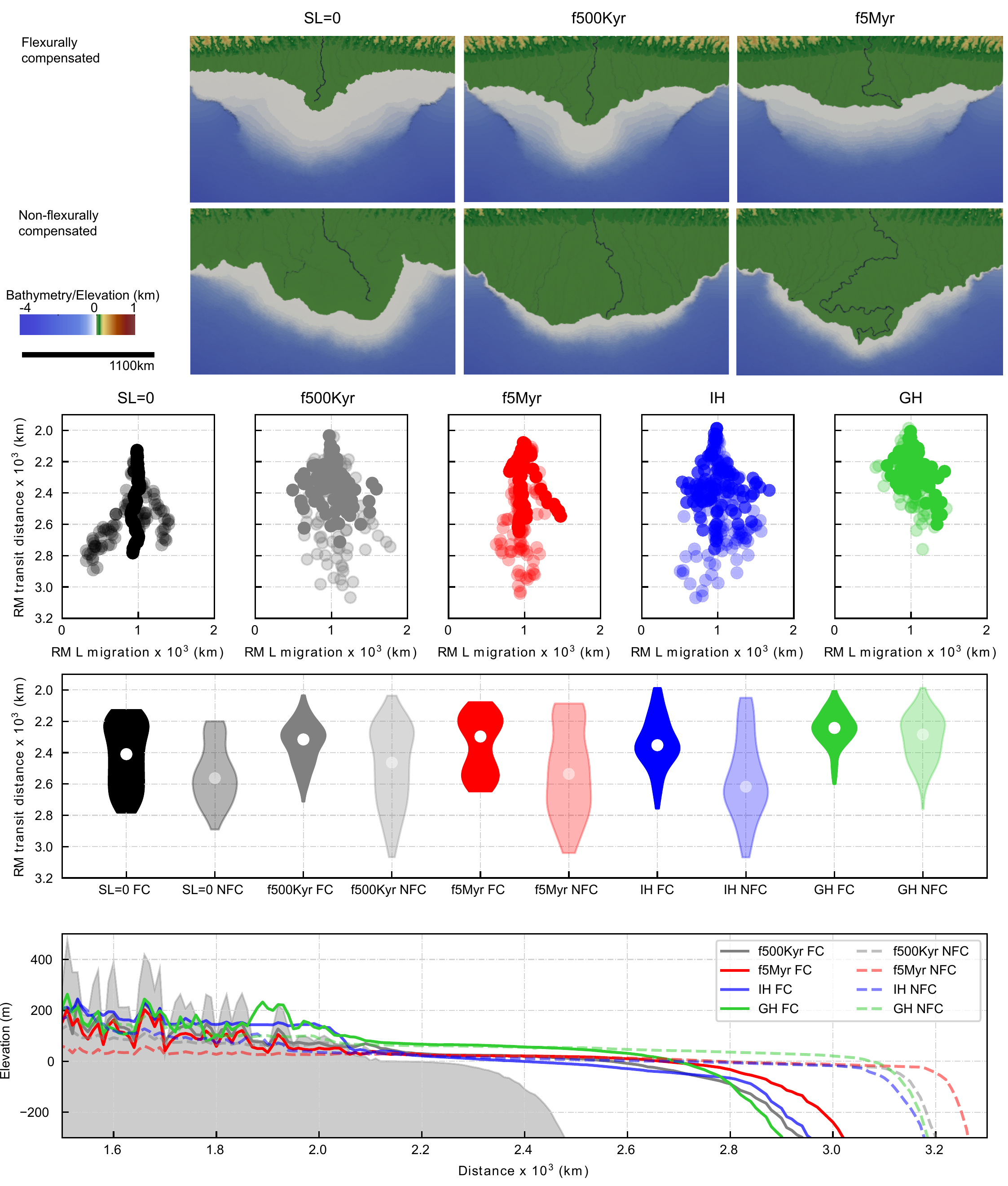
Abstract. The interplay between climate-forced sea level change, erosional and depositional processes, and flexural isostasy in deep time on passive margin deltas remains poorly understood. We performed a series of conceptual simulations to investigate flexural isostatic responses to high-frequency fluctuations in water and sediment load associated with climatically driven sea level changes. We model a large drainage basin that discharges to a continental margin and produces a large deltaic depocenter, then prescribe synthetic and climatic-driven sea level curves of different frequencies to assess flexural response. Results show that flexural isostatic responses are bidirectional over 100–1000 kyr timescales and are in sync with the magnitude, frequency, and direction of sea level fluctuations and that isostatic adjustments play an important role in driving along-strike and cross-shelf river mouth migration and sediment accumulation. Our findings demonstrate that climate-forced sea level changes produce a feedback mechanism that results in self-sustaining creation of accommodation into which sediment is deposited and plays a major role in delta morphology and stratigraphic architecture.
Compute Tags
None specified.
Software
Badlands
https://doi.org/10.5281/zenodo.1069573 · https://zenodo.org/record/1069573
Model Setup
Dataset (NCI catalogue):
https://thredds.nci.org.au/thredds/catalog/nm08/MATE/polanco-2024-deltas/catalog.html
Dataset existing identifier:
10.25914/4m82-y773
Dataset notes: The model output data is stored in a hdf5 format. You will see a h5 folder and a series of xdmf files. - h5 folder contains the hdf5 data, all the information computed by the model are stored in these files. You will have at least the tin (surface) and flow (stream network) dataset and also the sed (stratigraphy) data if the stratal structure is computed in your simulation. - two .xdmf files for the surface (tin_series.xdmf) and the flow network (flow_series.xdmf) that read the xmf files through time.
Model files (NCI catalogue):
https://thredds.nci.org.au/thredds/catalog/nm08/MATE/polanco-2024-deltas/catalog.html
Model files notes: Code and inputs for computational model
Source repository:
https://github.com/ModelAtlasofTheEarth/polanco-2024-deltas
Citation
Polanco, S., Blum, M., Salles, T., Frederick, B., Farrington, R., Ding, X., Mather, B., Mallard, C., & Moresi, L. (2024). Flexural isostatic response of continental-scale deltas to climatically driven sea level changes [Data set]. AuScope, National Computational Infrastructure. https://doi.org/4m82-y773
Licence
Funders
- Australian Research Council
- Australian–American Fulbright Commission
- The University of Melbourne