Strain and retrogression partitioning explain long-term stability of crustal roots in stable continents
Strain and retrogression partitioning explain long-term stability of crustal roots in stable continents
Away from tectonically active regions, the continental crust has an average thickness of 40 ± 1 km. Yet, it shows a remarkable variability from 25 to 65 km, comparable to that of the most tectonically active regions. Here, we consider the problem of the formation and preservation of anomalous deep crustal roots in stable intracontinental regions. Using two- dimensional thermomechanical experiments, we show that the interplay between partial melting, the formation of garnet-pyroxene-bearing rocks, and their strain rate–dependent retrogression result in the preservation of thick and strong crustal roots. We argue that it is the partitioning into narrow regions of strain, retrogression, and weakening coupled into a positive feedback loop that explains why strong high-grade crustal roots remain largely immune to gravitational stresses and are able to persist over hundreds of millions of years.
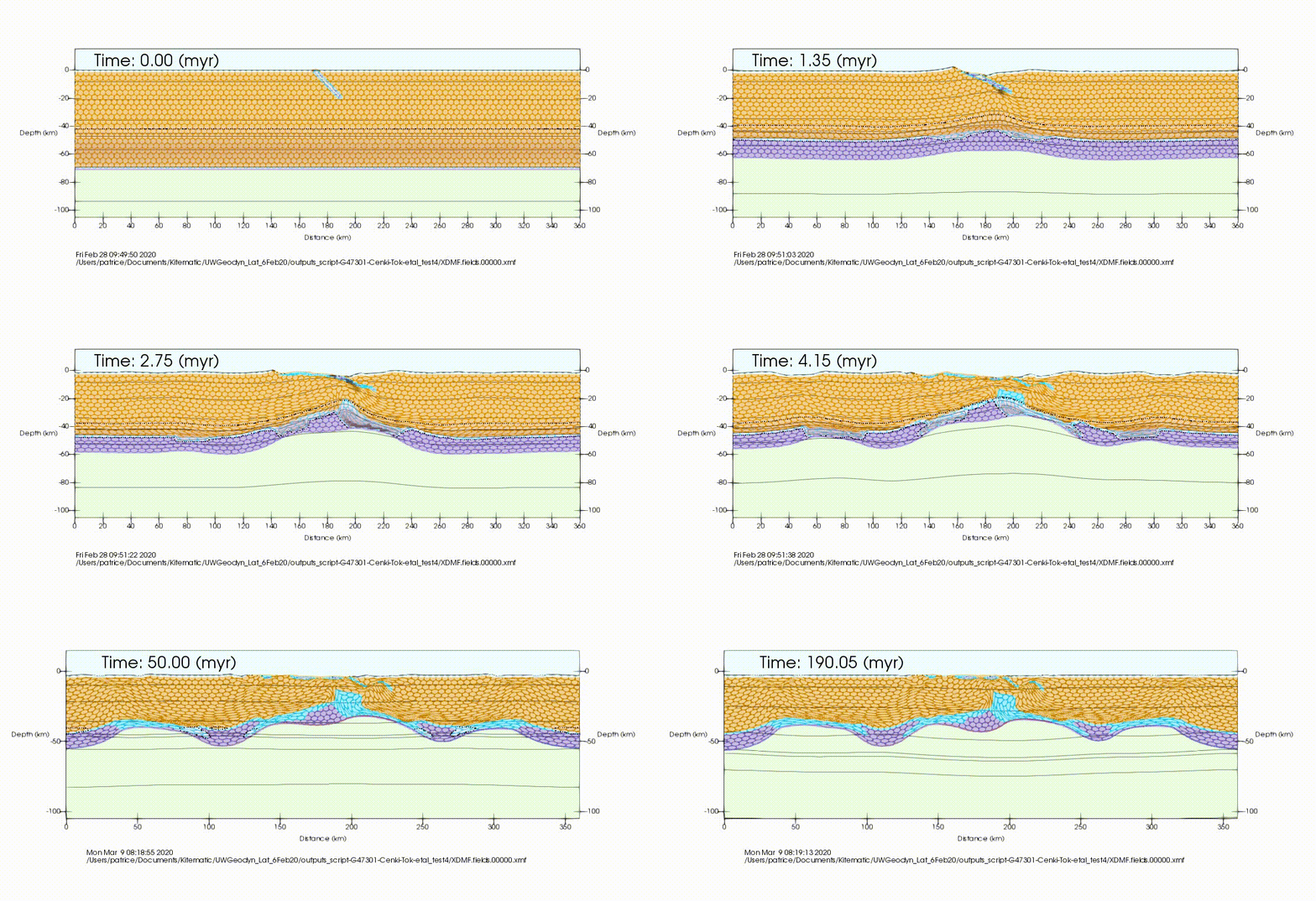
Research Tags
Associated Publication
Strain and retrogression partitioning explain long-term stability of crustal roots in stable continents
B. Cenki-Tok, P.F. Rey, D. Arcay
DOI10.1130/g47301.1
Abstract
Away from tectonically active regions, the continental crust has an average thickness of 40 ± 1 km. Yet, it shows a remarkable variability from 25 to 65 km, comparable to that of the most tectonically active regions. Here, we consider the problem of the formation and preservation of anomalous deep crustal roots in stable intracontinental regions. Using two-dimensional thermomechanical experiments, we show that the interplay between partial melting, the formation of garnet-pyroxene-bearing rocks, and their strain rate–dependent retrogression result in the preservation of thick and strong crustal roots. We argue that it is the partitioning into narrow regions of strain, retrogression, and weakening coupled into a positive feedback loop that explains why strong high-grade crustal roots remain largely immune to gravitational stresses and are able to persist over hundreds of millions of years.
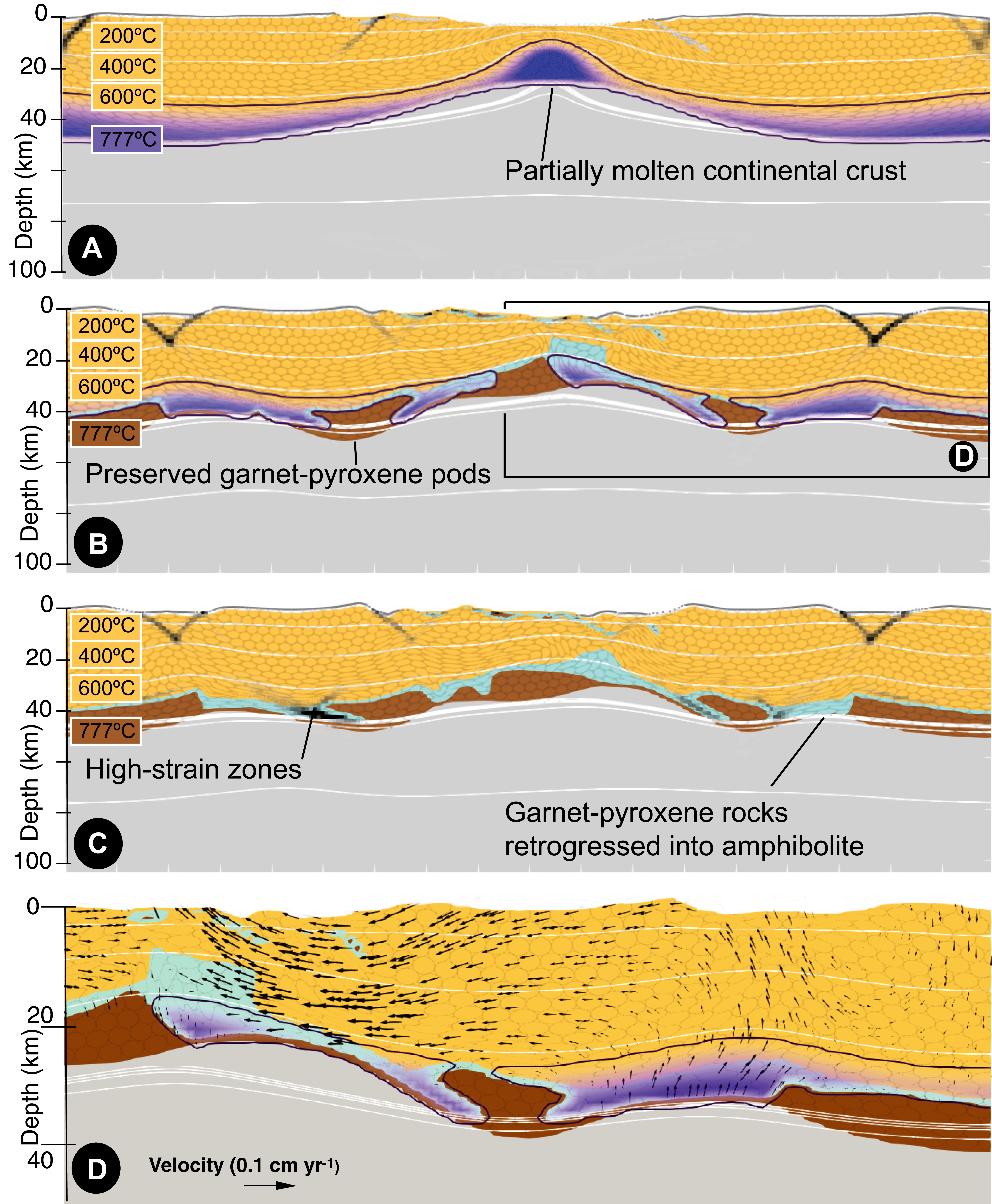
Compute Tags
None specified.
Software
Underworld 2
Model Setup
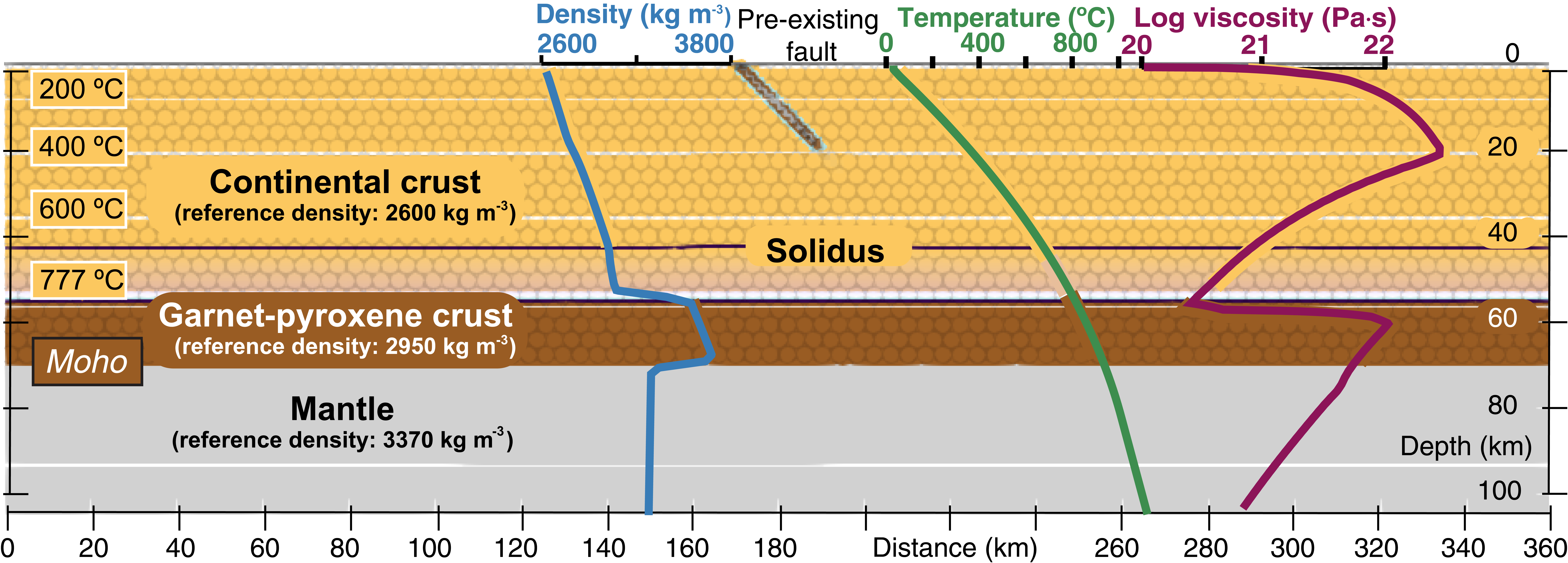
Model geometry, initial conditions as well as geotherm, viscosity and density profiles. A weak prismatic region dipping 45° simulates a detachment fault in upper crust. The circles pattern superimposed on the continental crust represents the finite strain ellipses.
Dataset (NCI catalogue):
https://thredds.nci.org.au/thredds/catalog/nm08/MATE/cenki-tok-2020-crustal-roots-in-stable-continents/catalog.html
Model files (NCI catalogue):
https://thredds.nci.org.au/thredds/catalog/nm08/MATE/cenki-tok-2020-crustal-roots-in-stable-continents/catalog.html
Model files notes: Code and inputs for computational model
Source repository:
https://github.com/ModelAtlasofTheEarth/cenki-tok-2020-crustal-roots-in-stable-continents
Citation
Cenki-Tok or Cenki, B., Rey, P., & Arcay, D. (2024). Strain and retrogression partitioning explain long-term stability of crustal roots in stable continents [Data set]. AuScope, National Computational Infrastructure. https://doi.org/tm6d-t466
Licence
Funders
- European Regions Research and Innovation Network